AI-native onboarding for fintech API providers

Turn your API spec into tutorials your clients actually finish

IntegrateMeFast drafts sandbox-validated, interactive tutorials from your OpenAPI spec, edits like a document, tracks every reader’s progress, and migrates your content automatically when the spec changes.

14-day trial, no credit card. Your first tutorial can be live today.

The platform

Everything between your docs and your client’s first successful call

Draft tutorials with AI, edit them like documents, track every reader, and stay aligned with your spec without lifting a finger twice.

Draft a full tutorial while you make coffee

Upload an OpenAPI spec and an agent team plans the integration path, writes every step, and mints runnable request examples against your sandbox. You review, tweak, and publish.

Tutorial job: Payment Company onboardingREADY
payouts-openapi.yaml148 endpoints parsed
Planner8-step integration path
Step writers8 drafts, in parallel
Sandbox validationevery request executed
Awaiting your review before anything goes live
An editor built for API walkthroughs

Every step is a rich document with live API request blocks inside: method, path, body, and the exact response to expect. Values captured from one response flow into later steps as variables.

GET/v1/payouts/{{payout_id}}
step 3 captures payout_id→step 4 sends it as a variable

Your catalog is versioned like code

Edit categories and endpoints on a working draft, review the field-level diff against production, and publish as the next version. Full history, exact diffs, and one-click restore when a release needs rolling back.

v9 production→draft→v10
+beneficiary.idnow required
~amountminimum raised to 1.00
-legacy_referenceremoved
endpoint ids kept, logs intactrestore any release

Migrations you approve, not surprises you find

When a new spec version lands, affected tutorials are flagged with exactly what moved. Approve one or all, and only the affected steps are rewritten. Working on the change while it is still a draft? Prepare the fixes first and ship everything together.

v3→v4 current3 tutorials flagged
Step 2 rewritten6 steps untouched

Know where every client stands

Each reader gets per-step progress, so you see who started, where they stall, and who finished, rolled up into activation metrics on your dashboard.

ana@acme.bizFinished
ops@globex.ioStep 6 of 8
dev@nimbuspay.devStep 3 of 8

The right ping at the right moment

An in-app notification center with realtime push covers generation runs, spec flags, and reader milestones. Signed webhooks and scoped API keys carry the same events into your own stack.

Payment Company onboarding is ready to publish2m
Spec v4 flagged 3 tutorials for migration1h
ops@globex.io finished onboarding3h

Runs with your stack, not beside it

Any REST API with an OpenAPI spec fits: API key or bearer auth, a sandbox per product, a client-facing reader portal with email-code sign-in, and request logs with a traceId from end to end.

OpenAPI 3.xGitHub ActionsAPI keysBearer authHMAC webhooksEmail-code sign-intraceId logs

The change flow

Every spec change under control, from draft to live

Updates never land blind: each catalog change is a draft with a diff, every affected tutorial is listed before anything goes live, and the prepared tutorial drafts publish together with the spec version in one act.

1. Edit on the draft→2. Review the diff→3. Prepare the tutorials→4. Publish all together

CI/CD

Your spec pipeline, wired into GitHub

One GitHub Action, three jobs: a pull request imports your OpenAPI document into a working catalog draft and comments the diff with every affected tutorial, you approve their migrations right in the PR comments, and merging publishes the catalog version, the spec version and the migrated tutorials all at once.

Preview without side effects

Every pull request imports the spec into a working draft with the exact diff. Your live catalog, sandbox logs and tutorials stay untouched until the merge.

Approve in the comments

The sync comment lists every affected tutorial. Reply with /imf approve to pick which ones migrate: anything unapproved is only flagged pending for later.

One act on merge

The merged spec becomes the next catalog version and the recorded spec version, the approved migrations run, and the migrated tutorials release together with everything else.

1. PR opens: draft + diff→2. Review the affected tutorials→3. /imf approve in the comments→4. Merge publishes everything

Access control

Private by default, precise when you need it

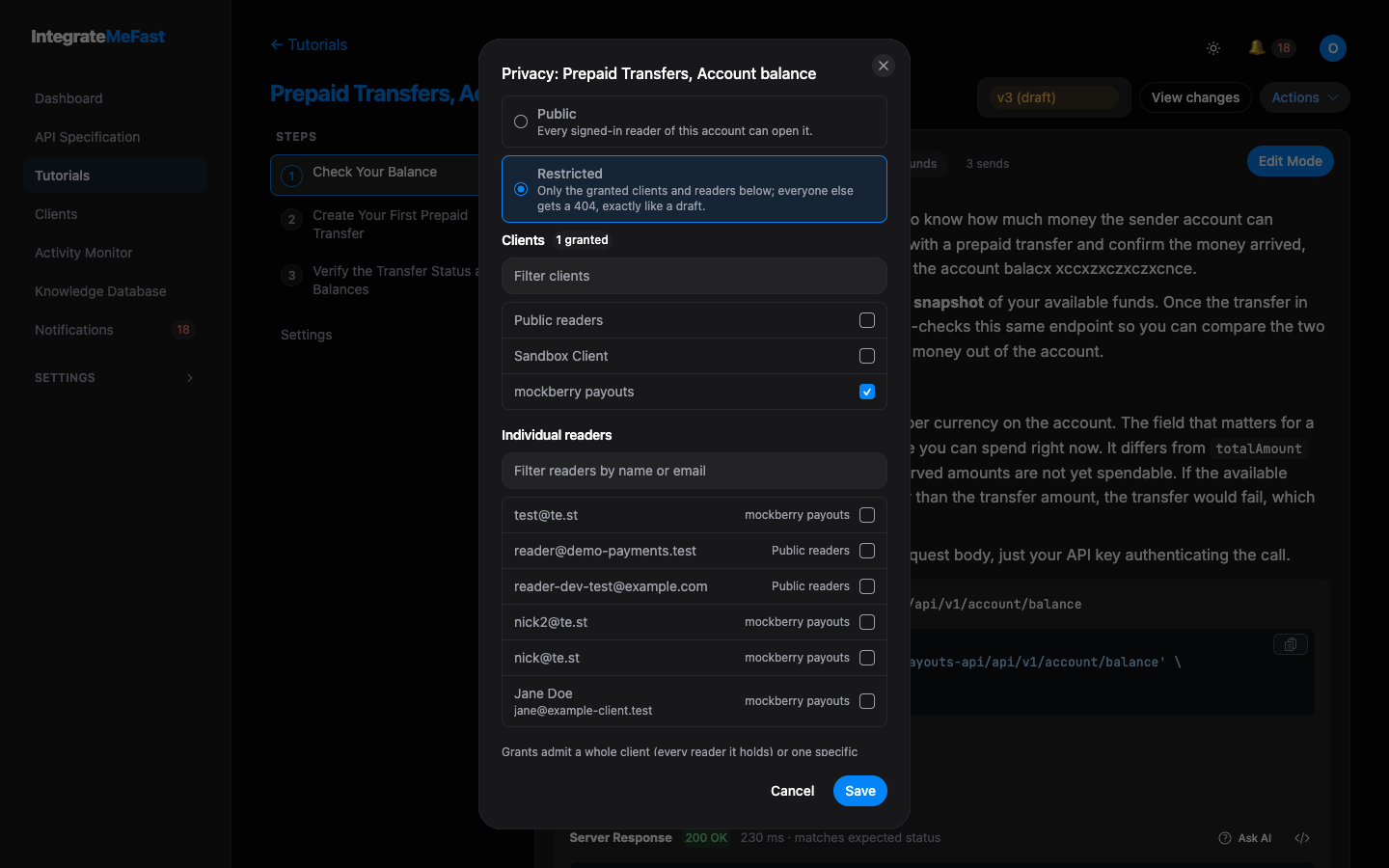
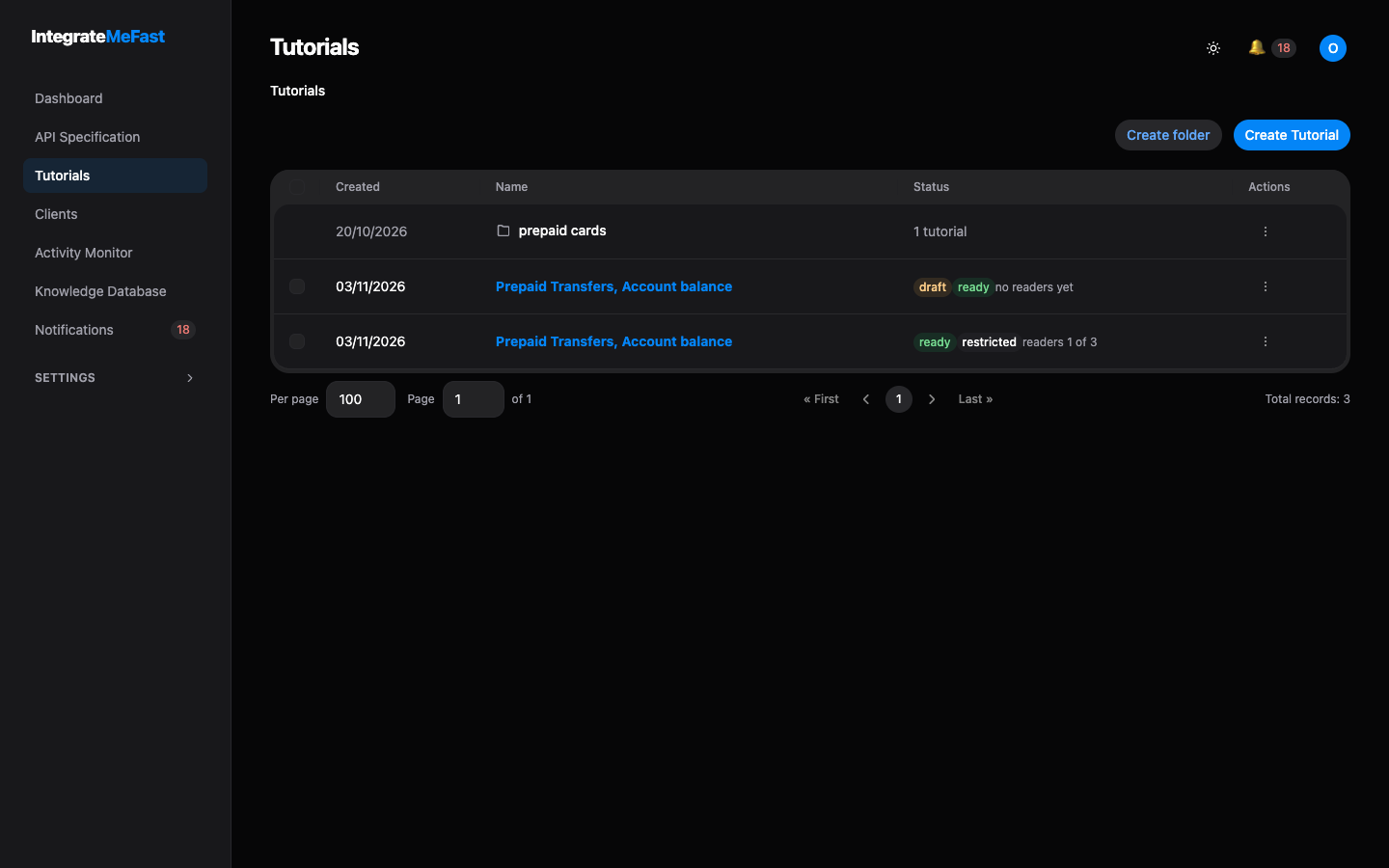
Published does not have to mean public. Every tutorial and every folder carries a privacy scope: open to all of your account’s readers, or restricted to exactly the clients and readers you name. The tutorials library even supports one-click duplication, so per-client variants never start from scratch.

Public or restricted, per item

One switch on every tutorial and folder. Restricted content answers a 404 exactly like a draft: it never reveals its own existence to a reader without a grant.

Client allow-lists

Grant a whole downstream customer in one click: every reader that client holds gets access, and any reader they invite later inherits it automatically.

Individual reader grants

For pilots and one-off reviews, name the exact reader instead of the whole client. Folder scopes are inherited by everything filed inside them.

Tutorialsrestricted
Tutorials list with restricted chips on tutorials and folders
Privacy: Payout onboardingRestricted
Privacy dialog with public and restricted scopes plus client and reader grants

Security and compliance

The controls your buyers’ compliance teams ask about, answered before they ask. Each feature below is a platform guarantee, not a roadmap item.

SOC 2 Type II

Audited controls for security, availability, and confidentiality. Reports are available under NDA, so your buyers’ vendor reviews move as fast as their integrations.

PCI DSS aligned

Cardholder data never touches the platform: tutorials exercise your payment APIs without storing a single PAN, so your flows stay on your provider’s certified rails.

GDPR ready

Reader data stays minimal and purpose-bound: progress and context, not personal payloads. Reader sessions are scoped per reader and removable on request.

Dedicated secret vault

Provider secrets are sealed in a vault, encrypted with AES-256-GCM. Plaintext keys are never persisted, never logged, and shown exactly once at creation.

Encrypted at rest

Every row, file, and backup is encrypted with AES-256. Encryption keys live in separate managed storage, never alongside the data they protect.

TLS in transit

Every hop runs over TLS: portal to API, API to agents, agent to provider. Nothing crosses the wire in the clear, including internal service traffic.

Redacted logs

Request and response bodies pass through redaction before they are persisted. You keep traceId-level visibility; payloads never leak into logs.

Scoped API keys

Machine-to-machine keys carry the imf_ prefix and least-privilege scopes. Only a SHA-256 hash is stored, and revocation is instant.

Sandbox tutorial mode

Readers learn on a sandbox-bound copy of your tutorial: every request resolves to your sandbox with platform-issued test keys. Public data only, no production credential, no real money.

How it works

From OpenAPI upload to a self-serve onboarding portal in four steps.

1

Upload your spec

Drop in an OpenAPI file or paste a URL. Endpoints, required fields, and auth are parsed into a product catalog, and every upload is versioned.

2

AI drafts the tutorial

The agent team plans the integration path, writes every step, and validates each request against your sandbox before you ever see it.

3

Review and publish

Polish in the built-in editor, compare the draft against released versions, and publish. Every release is immutable with one-click rollback, and clients get a guided portal with progress tracking.

4

Stay current

When the spec changes, the changelog shows what moved and which tutorials are affected. Prepare the fixes while the new catalog version is still a draft, then publish the spec and the tutorials in one act. Uploaded changes migrate on your approval, touching only the affected steps.

Time to first successful call

Illustrative: median days from spec upload to a client’s first 2xx response.

Readers who finish onboarding

Illustrative: share of started readers completing the final step, by week.

Finance benefits, measurable

Every feature maps to a metric you already track.

70%Typical TTV reduction

Cut time-to-value by 70%

AI-generated, sandbox-validated tutorials take clients from signup to first successful API call in hours, not weeks.

2×Conversion lift

Double trial-to-paid conversion

Clients who reach activation in the first week convert at 2× the rate. IntegrateMeFast is engineered around that first green run.

40%Ticket reduction

Reduce support cost per client

Known-issue knowledge base, automatic debugging hints, and rehearsed error handling deflect the long tail of integration tickets.

99.9%Integration uptime

Protect revenue with stability

Continuous sandbox health checks and webhook verification catch integration drift before it becomes churn.

3 weeks earlierFaster go-live

Launch production sooner

Production-readiness checklists and PCI DSS guidance remove the security review bottleneck at go-live.

Testimonials

What API providers say after the first quarter.

We cut client onboarding from 6 weeks to 9 days. The sandbox-first flow alone paid for the subscription in the first quarter.
Sara Lindqvist, Head of Partnerships at PayCore
The error simulator lets clients rehearse 429s and timeouts before go-live. Production incidents dropped 40% in the first month.
Marcus Chen, CTO at LedgerX
No-code clients now self-serve with AI-generated tutorials. Our support queue for integration questions shrank to almost nothing.
Elena Petrova, VP Integrations at NordFin
Tutorials are validated against a real sandbox before clients ever see them. Support tickets with reproduction steps became a thing of the past.
David Okafor, Platform Lead at SwiftPay
traceId across every log and run means our engineers see exactly what a client's request did. Debugging that used to take days now takes minutes.
Anna Kowalski, Head of API Products at MonoBank
Trial-to-paid conversion doubled. Clients reach first successful API call in day one and never look back.
Tom Alvarez, COO at GlobeRemit

Ready to cut your time-to-value?

Start free for 14 days. Import your OpenAPI spec on day one.